
The Products column used throughout is documented in Rule conditions.
Different products often cost differently to ship: a t-shirt travels in an envelope, a hoodie needs a box. Group products with WooCommerce shipping classes, and give each group its own pricing — product-class conditions are a Pro edition feature.
Classes, methods, options: what's what
Shipping classes should not be confused with shipping methods or shipping options.
Shipping options are what your customers see at checkout, such as "Overnight: $9.99" or "Economy shipping: $1.50".
Shipping methods are configured in the dashboard to determine which shipping options appear based on the order properties. Examples include Flat Rate, Local Pickup, or Weight Based Shipping.
Shipping classes are product attributes similar to tags or categories. Adding a shipping class to products, on its own, does not affect shipping options directly — but it lets shipping methods reference specific products, which is exactly what the rules below do.
Scenario A A separate rate per group
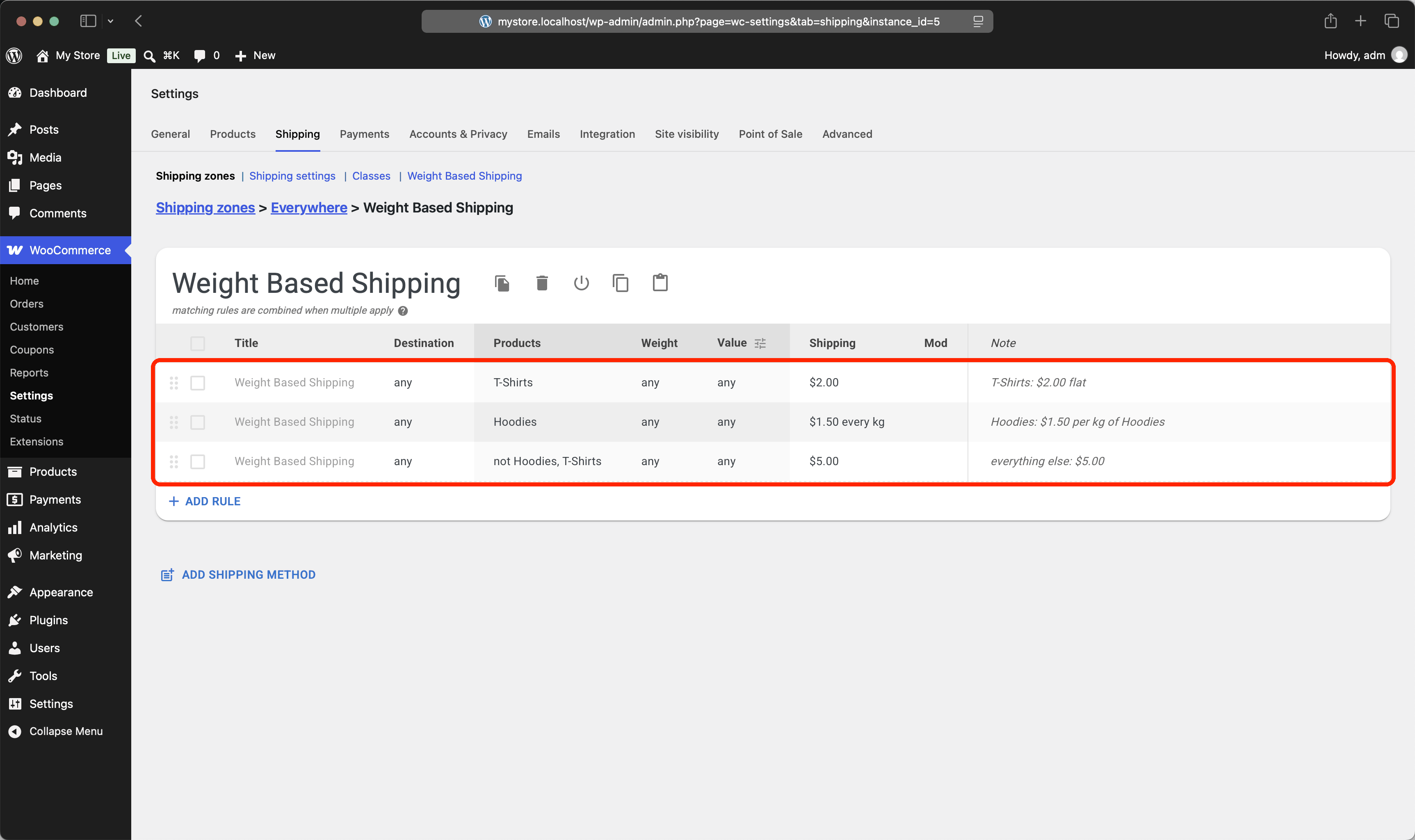
Each rule targets its own class in the Products column, prices its items — flat for T-Shirts, per-kilogram for Hoodies. The catch-all at the bottom is inverted — products without either class — so nothing is priced twice. Matching charges add up: a mixed cart pays the sum of its groups.
Example #1
Cart: a T-Shirt and 2 kg of Hoodies.
Result: $2.00 for the T-Shirt + 2 × $1.50 for the Hoodies = $5.00.
Example #2
Cart: a T-Shirt and a Cap (no class).
Result: $2.00 for the T-Shirt + $5.00 for the rest = $7.00.
Scenario B A surcharge for a product group
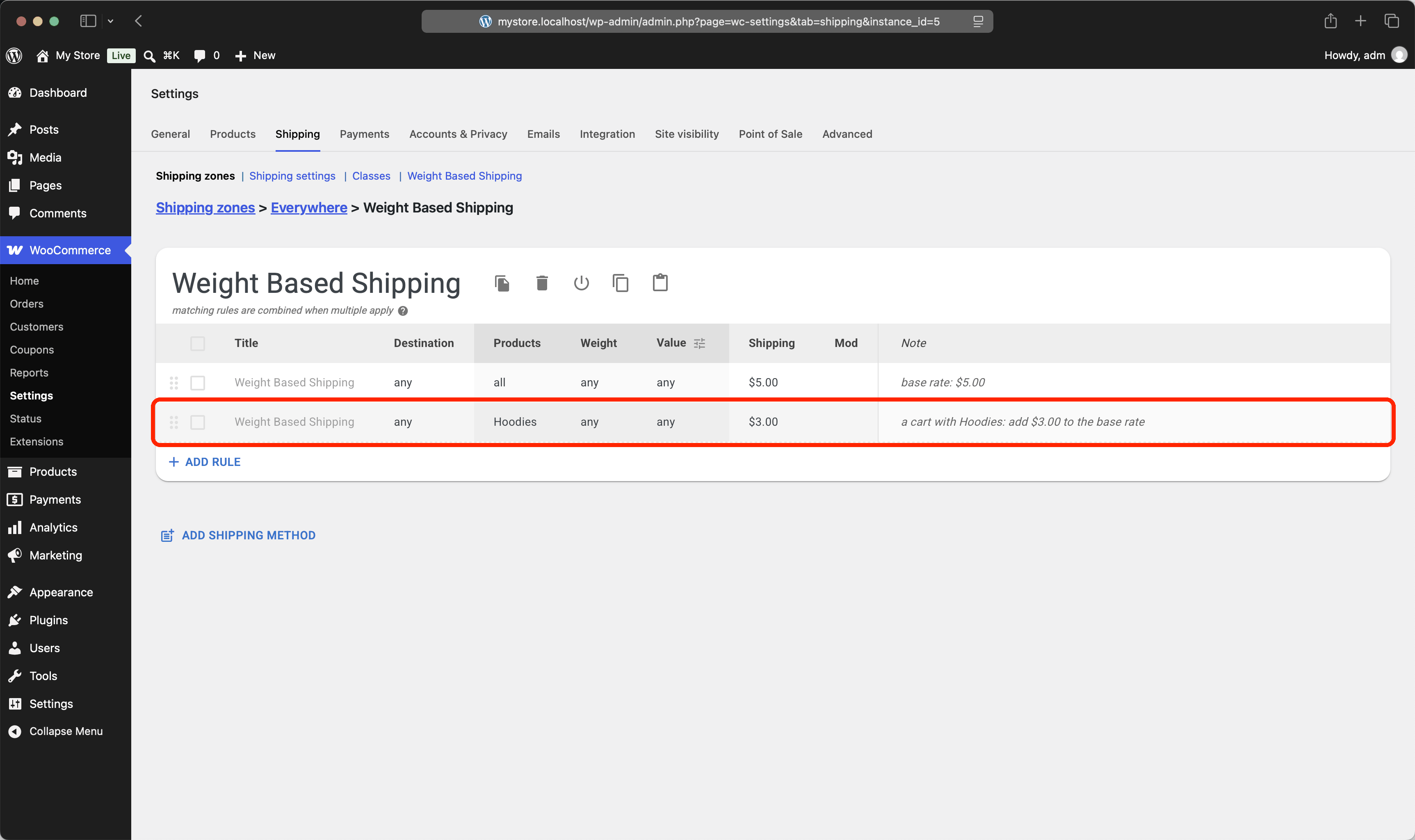
Rules don't have to be exclusive — matching rules are combined. Here every order pays the $5.00 base rate, and a cart containing anything from the bulky Hoodies class pays $3.00 on top.
Example #1
Cart: two T-Shirts.
Result: base rate only — $5.00.
Example #2
Cart: two T-Shirts and a Hoodie.
Result: $5.00 base + $3.00 surcharge = $8.00.
For finer control, the same class rules combine with weight brackets, order value, and destination conditions — each rule row is a free mix of all of them.