
The Shipping column of a rule says what it charges when it matches. Click the cell and you get four kinds of price: free, a flat amount, an amount repeated for every step of weight, or a flat amount plus a per-weight part. Everything the plugin can charge is a variation of the last one.
Kind Free shipping
Charges nothing. Useful as the free half of a threshold setup, and as a deliberate "this part of the cart ships at no cost" contribution in a mixed order.
Remember that free means adds zero, not overrides everything. If another rule in the same table also matches, its charge still counts. See How rules work for why, and Free shipping over an amount for the working pattern.
Kind Flat: one price for the order
A fixed amount, regardless of weight: $9.50 for everything. This is the shape of most per-country rates, handling fees, and per-class surcharges. Combined with a weight range it also gives you classic weight brackets — a flat price per bracket, which is what most carriers actually sell, and what Shipping by weight builds.
Kind Incremental: a price per kg or per lb
An amount repeated for every step of weight: $1.50 every 0.5 kg. You give the charge and the step size. This is the shipping cost per kg — or per lb, or per whatever unit your store uses.
Steps are counted up, not proportionally. A started step costs a full step, because that is how carriers price parcels. At $1.50 every 0.5 kg, a 0.1 kg cart costs $1.50, a 0.6 kg cart costs $3.00, and a 1.0 kg cart costs $3.00 as well.
If you want a straight multiplication instead, set the step to 0. Zero is a special value meaning "no steps": the charge becomes a true price per unit, and the cell reads $1.50/kg. A 1.5 kg cart then costs exactly $2.25 at $1.50/kg.
Kind Base + incremental: flat plus a progressive rate
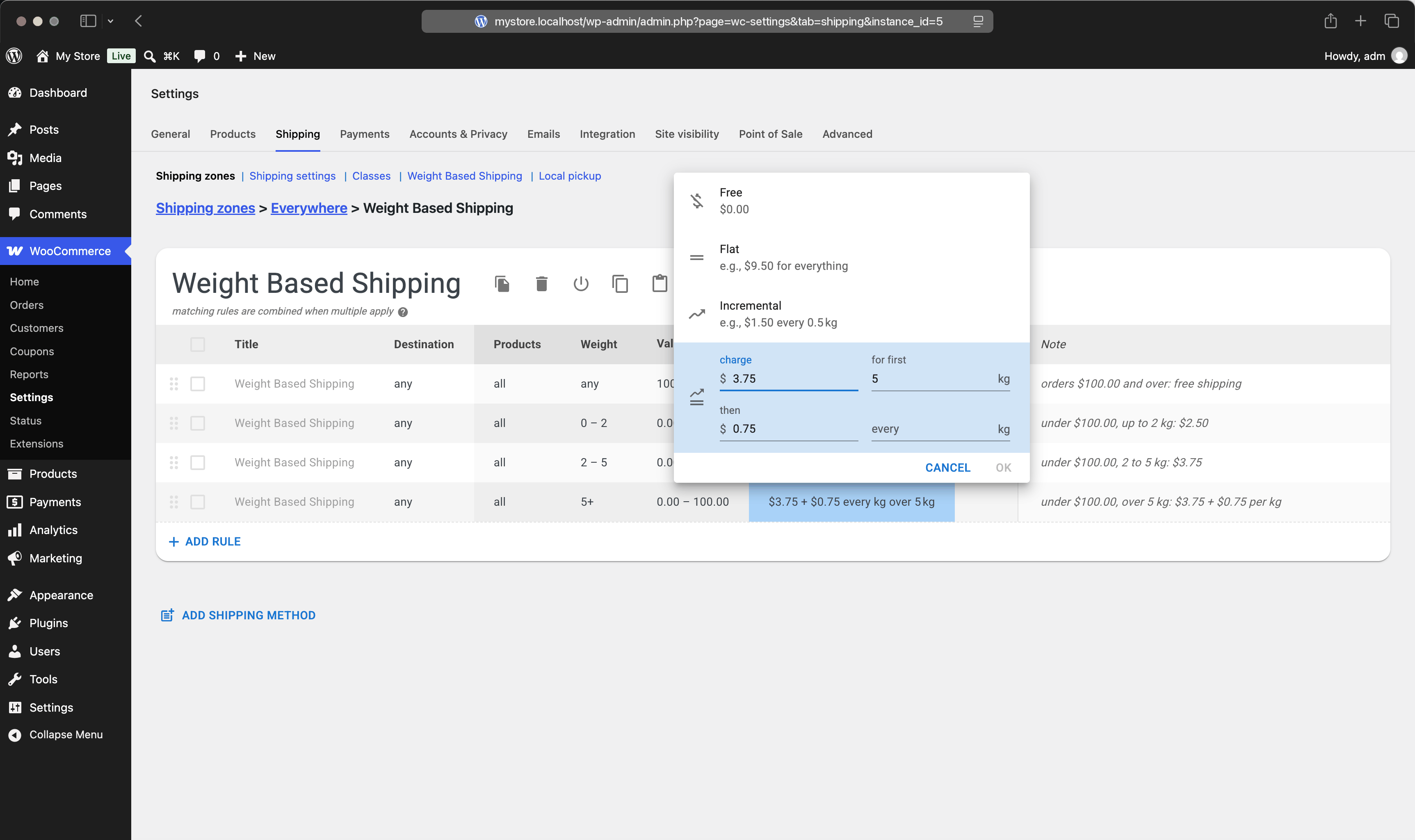
The full form, listed as Flat + Progressive on the plugin's WordPress.org page: a flat part, an amount of weight that the flat part already covers, and a per-step charge for the rest. The editor spells it out — $9.50 for first 3 kg, then $1.50 every 0.5 kg — with fields charge, for first, then, and every.
This is the shape carriers describe as "X for the first N kg, then Y per additional kg", and it is the reason a single rule can cover an open-ended weight range instead of a long ladder of brackets. Shipping per lb works the same three prices in pounds.
Example #1
Rule: $9.50 for first 3 kg, then $1.50 every 0.5 kg.
Cart: 2.4 kg.
Result: the weight is inside the first 3 kg, so shipping costs $9.50.
Example #2
Cart: 4.2 kg.
Result: 4.2 kg is 1.2 kg above the first 3 kg, which is three started steps of 0.5 kg,
so shipping costs $9.50 + 3 × $1.50 = $14.00.
The formula
All four kinds are the same calculation with parts left out, using the labels the editor puts on the fields:
price = charge + steps × then, where steps is the weight above "for first", divided by "every", rounded up to a whole number. When the weight does not exceed "for first", only the flat part is charged. When "every" is zero, the weight above "for first" is multiplied directly instead of counted in steps.
Two consequences are worth keeping in mind. The weight used is the weight the rule sees, which is the whole cart unless the rule narrows it with the Products column. And the arithmetic is exact — the plugin hands WooCommerce an unrounded number, and WooCommerce rounds it for display and adds tax if your tax settings say so.
Negative charges
Nothing stops you from entering a negative amount, and it does what you would expect: WooCommerce receives it unchanged, and it subtracts from the total of the matching rules. A rule that matches a promotional class with a charge of −$5.00 takes five dollars off the shipping of any order containing those items.
Modern WooCommerce accepts a negative shipping option and floors the order total at zero. Older versions did not allow negative shipping at all.
Price caps, percentages, and formulas
There is no minimum or maximum shipping price, no percentage of the order value, and no formula language. Prices are the four kinds above and nothing else. A price cap has to be expressed as rules — a bracket above the cap weight that charges the capped flat amount. Limits and workarounds lists the rest of the boundaries.